VAT (btw) for freelancers in the Netherlands: the complete guide (2026)
VAT (in Dutch: btw) is part of running a business, but it's less complicated than it looks. This guide explains, in plain English, what VAT is, which rates exist, and how to file your return.
It's an overview. For the details, each section has a link.
What is VAT?
VAT is a tax on goods and services. You charge VAT to your clients and pass it on to the tax office (Belastingdienst). So the VAT is not yours — you are the pass-through.
But you also pay VAT yourself on your costs. You can reclaim that. It's called input VAT (voorbelasting).
The rates
- 21% — the standard rate for most goods and services.
- 9% — the low rate, for example food, books and some services.
- 0% or exempt — for certain cases, such as exports.
On your invoice you always show which rate you use. More on that in the invoicing guide.
Input VAT: reclaiming VAT
Every time you buy something for your business with VAT, you can reclaim that VAT. So keep your receipts — every lost receipt is VAT you miss out on.
The KOR: small business scheme
Do you have less than € 20,000 in revenue per year? Then you can join the KOR (kleineondernemersregeling). You then charge no VAT to clients and file no VAT return. Handy, but you also can't reclaim input VAT. Read when the KOR is and isn't smart in The small business scheme explained.
Filing your VAT return
Most freelancers file every quarter: VAT on your sales, minus your input VAT, is what you pay or get back. The full step-by-step is in How to file your Dutch VAT return.
In BoekBrug your VAT is always ready
In BoekBrug your sales and VAT are added up per quarter automatically. Upload your bank statement and BoekBrug matches payments to your invoices. So your return is as good as done.
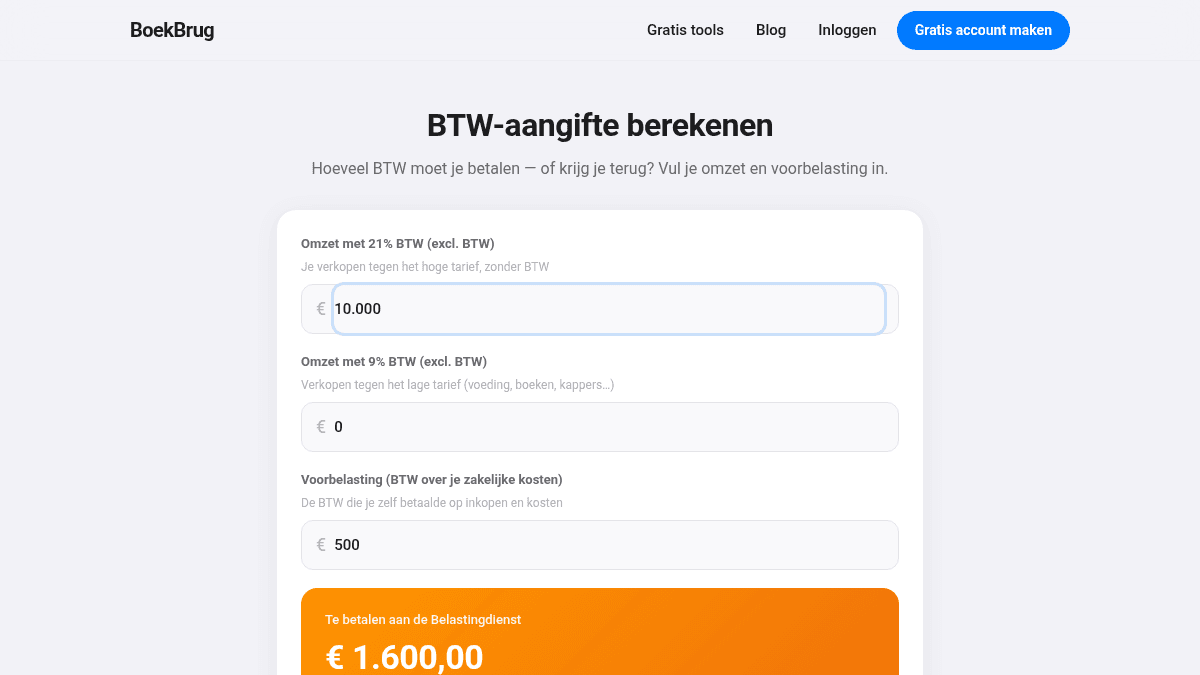
Want to know quickly what you owe? Use the free calculator below.
Important
This is a general explanation, not tax advice. Unsure? Check belastingdienst.nl or ask your bookkeeper.