The Dutch small business scheme (KOR) explained: is it right for you?
Do you have a small revenue? Then you can join the small business scheme (kleineondernemersregeling, KOR). You then charge no VAT and file no VAT return. Handy — but not always smart. Here's the simple version.
What is the KOR?
The KOR is a VAT exemption for businesses with small revenue. If you join, you:
- charge no VAT to your clients,
- file no VAT return,
- but also cannot reclaim input VAT (the VAT on your costs).
The limit: € 20,000 revenue
You may join if your revenue stays below € 20,000 per year. Go above it, and the KOR stops from that moment and you charge VAT again. Your revenue before that stays exempt.
When is the KOR smart?
The KOR fits well when:
- you mostly sell to private customers (they can't reclaim VAT anyway, so your price is lower for them), and
- you have few business costs (so you miss little input VAT).
When is it not?
The KOR is often less smart when:
- you mostly sell to businesses (they don't mind VAT, because they reclaim it), or
- you make many costs with VAT (because you then can't reclaim that VAT). Think of a start with big investments.
What goes on your invoice?
If you join the KOR, you put no VAT on your invoice. You add a short note that you are exempt, for example: "VAT-exempt under the KOR scheme". More on invoices in the invoicing guide.
How do you register?
You register with the Belastingdienst. Note: if you join, you are generally committed for a few years. So think carefully about whether it suits you — or ask your bookkeeper.
Unsure? Do the maths
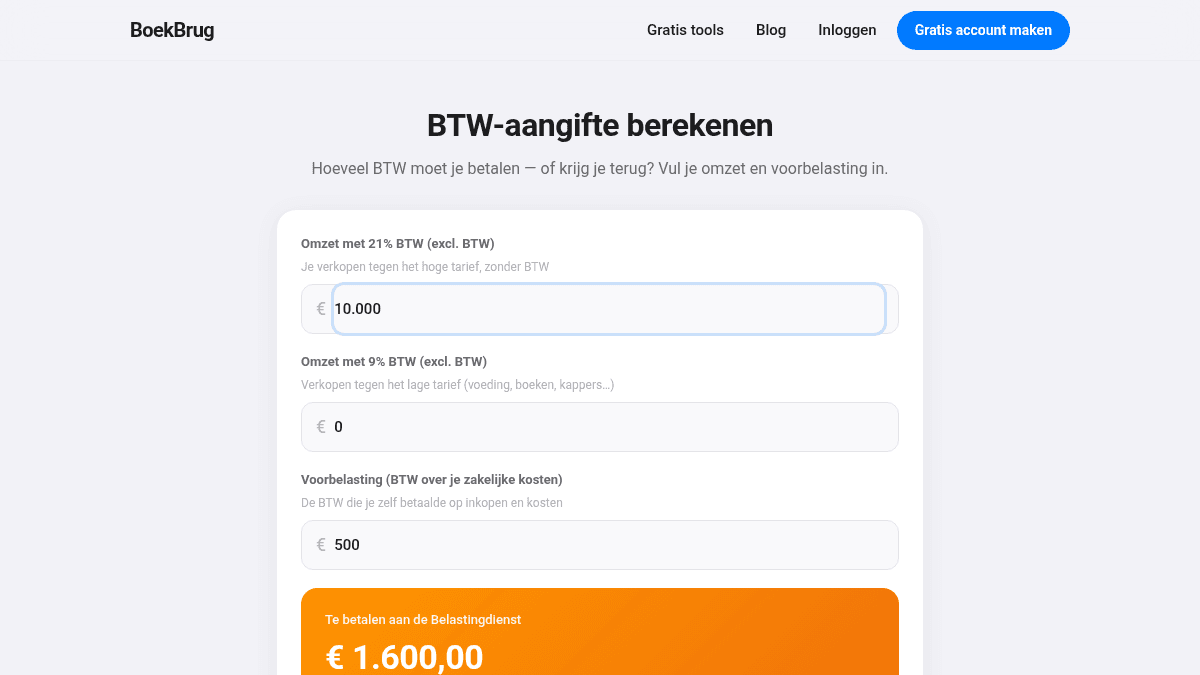
Whether the KOR pays off depends on your clients and your costs. Calmly work through a few situations. Our free VAT tool below helps you quickly see how much VAT is in an amount.
Important
This is a general explanation, not tax advice. For your situation, check belastingdienst.nl or ask your bookkeeper.