Freelancer tax deductions in the Netherlands 2026: which ones and how much they save
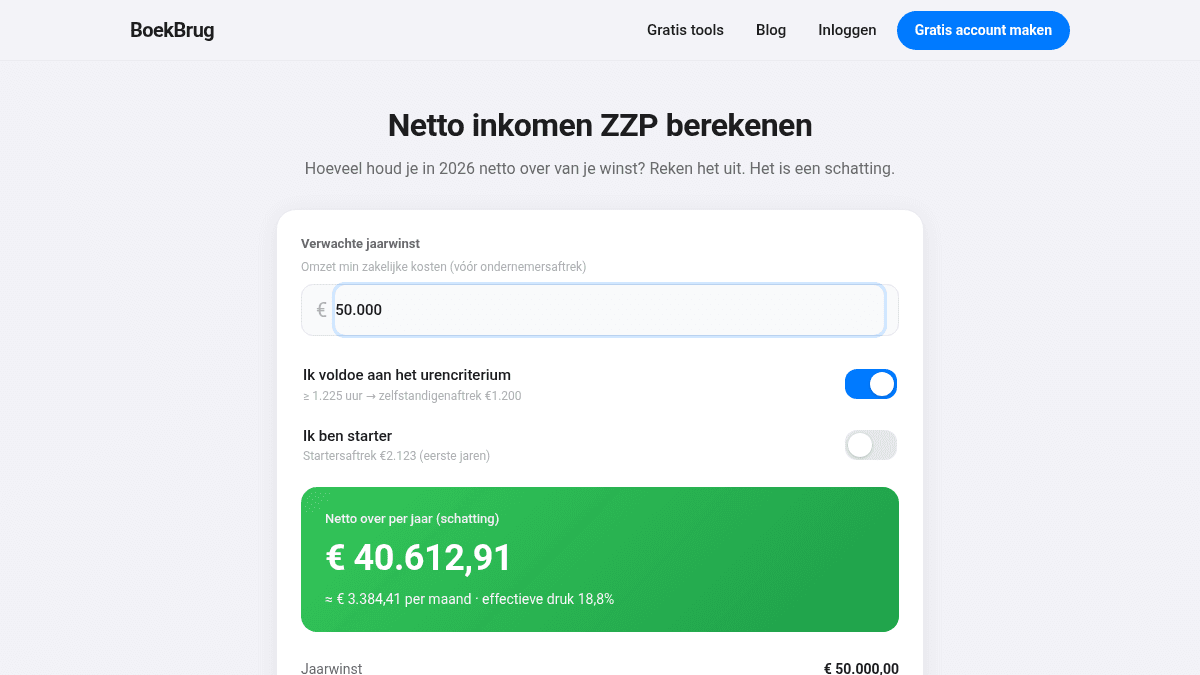
As a freelancer (ZZP'er) you pay tax on your profit, not your revenue. And thanks to deductions, that profit for tax is often lower than you expect. Here is a plain-English overview of the 2026 deductions and how much they save.
First, the difference: costs vs. entrepreneur deduction
There are two kinds of "deduction":
- Business costs — real expenses for your work. You subtract these from your revenue to get your profit.
- Entrepreneur deductions and exemptions — extra tax benefits you may subtract from your profit, even though you did not actually spend that money.
We'll walk through both.
1. Business costs
Anything you reasonably spend for your business is deductible. Think of:
- equipment and tools, software and subscriptions;
- part of your phone and internet;
- business kilometres — in 2026 € 0.25 per kilometre with your private car;
- training and professional literature, insurance, and your bookkeeping costs.
Always keep the receipts and invoices. No proof = no deduction.
2. Self-employed deduction — € 1,200
Do you meet the hours criterion (at least 1,225 hours per year in your business)? Then you may subtract the self-employed deduction (zelfstandigenaftrek) of € 1,200 from your profit. Note: this amount has fallen sharply in recent years (in 2025 it was still € 2,470).
3. Starter's deduction — € 2,123
Just started? In your first years you may get the starter's deduction (startersaftrek) of € 2,123, on top of the self-employed deduction. Together that is € 1,200 + € 2,123 = € 3,323 of entrepreneur deduction.
4. SME profit exemption — 12.7%
After the entrepreneur deduction you may subtract another 12.7% of what remains: the SME profit exemption (MKB-winstvrijstelling). Nice detail: for this you do not need to meet the hours criterion. So you always get it, even without the 1,225 hours.
5. Investment deduction (KIA)
Did you invest a substantial amount in business assets in a year? Then you may be entitled to the small-scale investment deduction (KIA) — an extra deduction on top of the cost. There is a minimum amount per year; check the current threshold with the Belastingdienst or your accountant.
The order: how it adds up
This is how the tax office calculates it:
- Revenue minus business costs = profit.
- Subtract the self-employed deduction (€ 1,200) and, if applicable, the starter's deduction (€ 2,123).
- From what remains, subtract the SME profit exemption (12.7%).
- Only over that amount do you pay income tax (and the Zvw health contribution).
Every step lowers your taxable profit. That is why freelancers often keep more than the "headline" tax rate suggests.
How BoekBrug helps
Using your deductions starts with complete records: every receipt and invoice kept, nothing forgotten. In BoekBrug you scan receipts with your camera, keep your invoices, and everything is ready for your tax return and your accountant. That way you leave no deduction on the table.
Curious what you keep after deductions? Calculate it below, or make a free account to record your costs properly from day one.