Keeping receipts and invoices: how long, and how to make it easy
Do you really have to keep every receipt? Yes. And longer than you think. The Dutch tax office (Belastingdienst) can ask to see your records later. If you can't show anything, you have a problem.
Luckily, it doesn't have to be a shoebox full of paper.
How long must you keep records?
The basic rule is simple: you keep your records for 7 years. That covers:
- Invoices you sent and received.
- Receipts for business purchases.
- Your bank statements and your VAT returns.
For records about real estate (like a business building) a longer period applies: 10 years.
Paper or digital?
Good news: you may keep everything digitally. A photo or scan of a receipt is enough, as long as it is clearly readable. You don't have to keep the paper afterwards.
That helps, because paper receipts fade. After a year in a drawer the ink is often gone. A photo stays readable forever.
The biggest mistake: saving it all for the end
Many freelancers throw receipts in a folder and only deal with them at year-end. That costs a whole day of sorting — and some receipts are always missing. Every lost receipt is VAT you can't reclaim. That is a waste of money.
Better: capture it right away. A receipt at the till? Take a photo immediately. Done.
How BoekBrug makes it easy
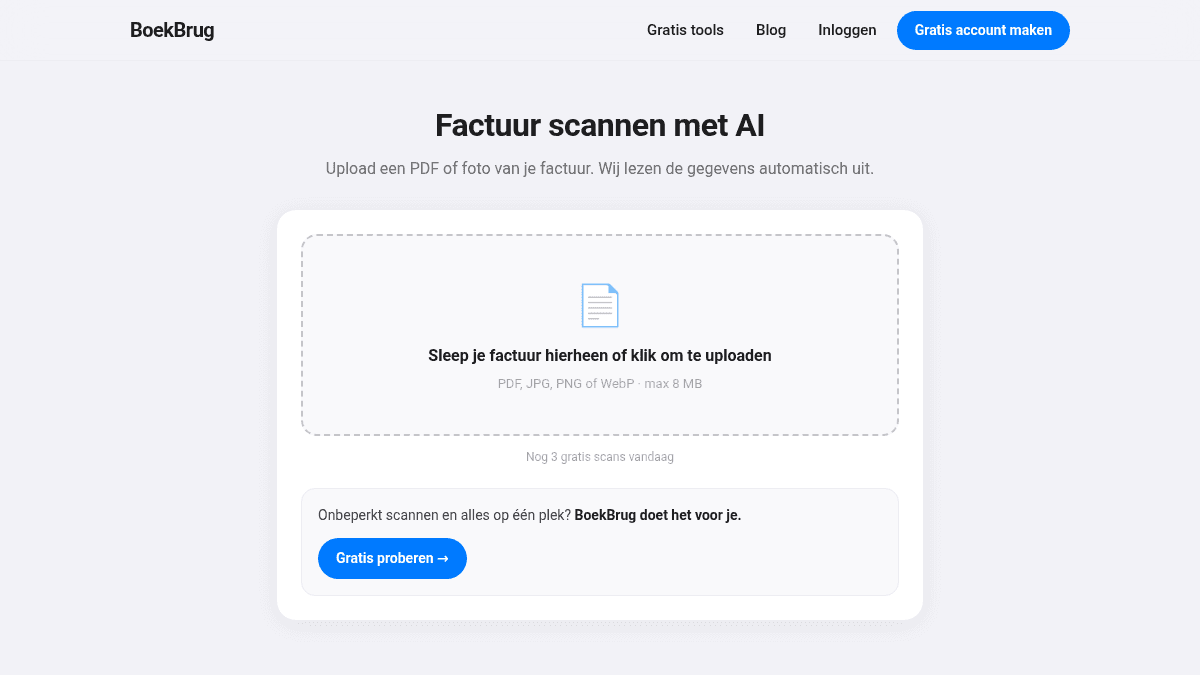
With BoekBrug's invoice scanning you take a photo or upload a PDF. The AI automatically reads the supplier, the amount and the VAT. You don't have to type anything.
Everything is stored digitally and organised together in your files, so you can find it easily after 3 or 6 years. And because your VAT is captured right away, you no longer miss a deduction.
Your data stays yours: you can export or delete it at any time (GDPR-proof).
Try the scanning below.