Net income as a freelancer (ZZP) in 2026: how much do you keep?
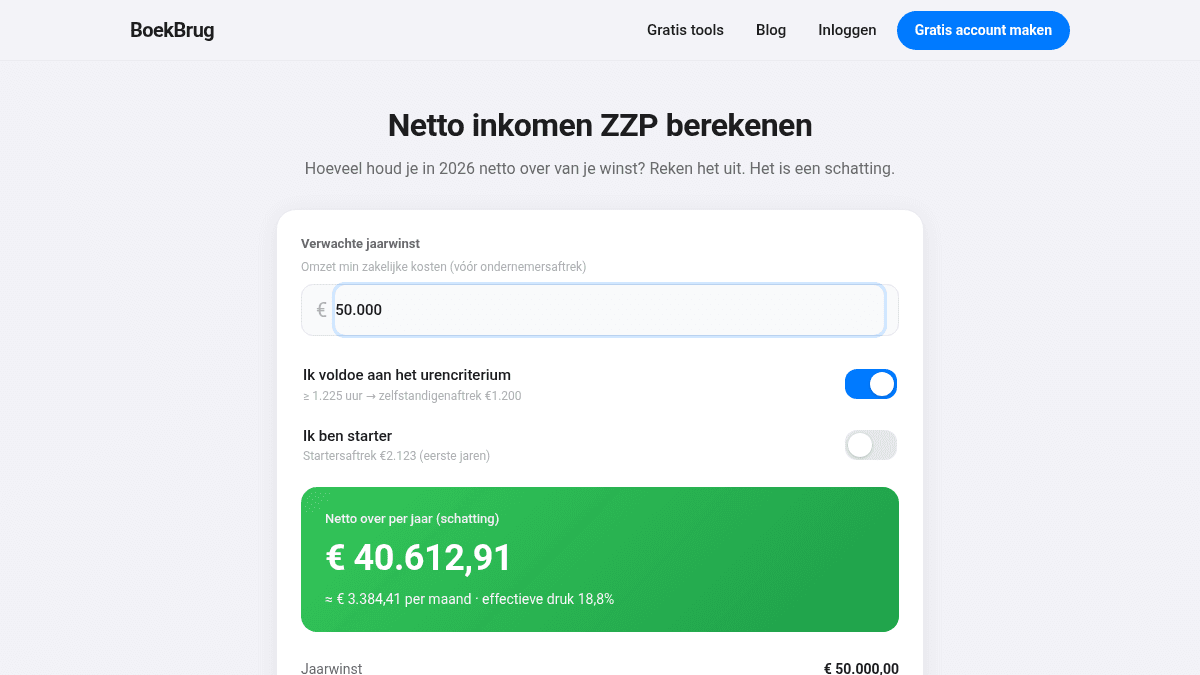
As a freelancer in the Netherlands (a ZZP'er), you don't pay tax on your revenue — you pay it on your profit. And thanks to deductions and tax credits, you keep more of that profit than you might expect. Still, 2026 is a tighter year: the self-employed deduction (zelfstandigenaftrek) has been cut again, to € 1,200. So plenty of freelancers are wondering what's actually left at the end.
This guide walks you step by step from revenue to net income, using the 2026 rates, with a full worked example. You'll see exactly where your money goes — and what you can influence.
From revenue to net income in four steps
- Revenue → profit: subtract your business expenses from your revenue.
- Entrepreneur deduction: subtract the self-employed deduction (and, if you qualify, the starter's deduction) from your profit.
- SME profit exemption: 12.7% of what remains is exempt.
- Tax & contributions: on the taxable amount you pay income tax (minus tax credits) plus the Zvw healthcare contribution.
Whatever is left is your net income. Let's take them one at a time.
Step 1 — From revenue to profit
Your revenue is everything you invoice to clients (excluding VAT — that isn't yours). From it you subtract your business expenses: software, your laptop, travel, insurance, your phone, training, and so on. What remains is your profit from the business (winst uit onderneming).
Use revenue excluding VAT. The VAT you collect from clients is paid on to the tax office — it doesn't count as income.
You calculate everything else on that profit — not on your full revenue. Keeping good track of your expenses lowers your profit, and therefore your tax.
Step 2 — Entrepreneur deduction: the self-employed deduction
If you meet the hours criterion (urencriterium — at least 1,225 hours a year in your business), you may deduct the self-employed deduction from your profit. In 2026 that is € 1,200 — much lower than a few years ago, as the government phases it out step by step.
Are you a starter? In your first years you also get an extra € 2,123 starter's deduction on top. Together that's € 3,323 off your profit.
If you don't meet the hours criterion, the self-employed deduction falls away and you continue with your full profit.
Step 3 — SME profit exemption
After the entrepreneur deduction you apply the SME profit exemption (MKB-winstvrijstelling): 12.7% of your remaining profit is exempt from tax. It's automatic — you just have to be an entrepreneur.
Take 12.7% off € 48,800 of profit (after the deduction) and € 6,198 is exempt. Your taxable income in box 1 then becomes € 42,602.
Step 4 — Income tax, tax credits and Zvw
On your taxable income you pay box 1 income tax. The 2026 brackets:
| Taxable income | 2026 rate |
|---|---|
| Up to € 38,883 | 35.75% |
| € 38,883 – € 78,426 | 37.56% |
| Above € 78,426 | 49.50% |
Two tax credits are then subtracted from the calculated tax:
- General tax credit (algemene heffingskorting) — up to € 3,115, tapering off as you earn more.
- Labour tax credit (arbeidskorting) — up to € 5,685 for people who work; it also tapers off at higher incomes.
These credits reduce your tax directly and are the reason your net figure is often better than expected.
Finally you pay the income-dependent healthcare contribution (Zvw): 4.85% of your contribution income (capped at € 79,409 in 2026). The tax office collects this separately, on top of your regular health-insurance premium.
Worked example: € 60,000 revenue
Say you invoice € 60,000 in 2026 and have € 10,000 of business expenses. You meet the hours criterion and are no longer a starter.
| Step | Amount |
|---|---|
| Revenue | € 60,000 |
| Less: business expenses | − € 10,000 |
| Profit | € 50,000 |
| Less: self-employed deduction | − € 1,200 |
| Profit after deduction | € 48,800 |
| Less: SME profit exemption (12.7%) | − € 6,198 |
| Taxable income (box 1) | € 42,602 |
| Income tax (brackets 1 + 2) | € 15,298 |
| Less: general + labour tax credit | − € 7,977 |
| Income tax payable | € 7,321 |
| Zvw contribution (4.85%) | € 2,066 |
| Total paid | € 9,387 |
| Net income | ≈ € 40,613 |
So on € 60,000 of revenue you keep roughly € 40,613 net in this example — about € 3,384 a month. Your average tax burden on profit works out at around 18.8% — relatively low, precisely because of the entrepreneur deduction, the SME profit exemption and the tax credits.
What can you influence?
- Track your expenses carefully. Every euro of business expense lowers your profit and your tax. A lost receipt is money thrown away.
- Guard the hours criterion. Without the 1,225 hours you lose the € 1,200 self-employed deduction.
- Set money aside for tax. Park part of your revenue each month. As a rule of thumb, many freelancers keep back 25–35% of profit for the assessment and the Zvw.
- Think about pension. Setting aside part of your profit in a tax-friendly way (for example via an annuity, lijfrente) can lower your taxable income.
Important: this is an estimate, not tax advice
The calculation above is an indication based on the 2026 rates. Your personal situation may differ: a tax partner, other income alongside your business, allowances (toeslagen), the exact build-up and taper of your labour tax credit, or deductions such as an annuity. Rates can also change during the year.
Use this article to understand the structure — not as a final tax return. For your exact figures, consult the Belastingdienst or your bookkeeper. In doubt? A good bookkeeper often pays for itself.