The self-employed deduction (zelfstandigenaftrek) in 2026: simply explained
Are you a freelancer (ZZP'er) in the Netherlands? Then the zelfstandigenaftrek — the "self-employed deduction" — is one of your most useful tax breaks. In 2026 it is € 1,200. You subtract that amount from your profit before you pay tax. So you keep more.
This guide explains it in plain language. No jargon.
What is the self-employed deduction?
It is a fixed amount that you may subtract from your profit (not your revenue) before income tax is calculated. Less taxable profit means less tax.
One rule: the deduction cannot push your profit below € 0. It cannot create a loss. Any leftover part moves to the next year.
How much is it in 2026?
| Year | Self-employed deduction |
|---|---|
| 2025 | € 2,470 |
| 2026 | € 1,200 |
The amount keeps dropping. The government has been lowering it step by step since 2020. For 2026 it is € 1,200. Do not use old numbers — that makes your estimate wrong by hundreds of euros.
The hours rule (urencriterium)
You only get the deduction if you meet the hours criterion (urencriterium):
- You spend at least 1,225 hours a year on your business, and
- you spend more time on your business than on other work (like a paid job).
Those 1,225 hours cover all business time — not only billable hours. Admin, finding clients, your website, travel and training all count. Over a full year, 1,225 hours is about 24 hours a week.
Keep track of your hours. If the tax office asks, you must be able to show you reached 1,225 hours. A simple time log is enough.
Do you not meet the hours rule? Then you lose the deduction for that year. You still keep the SME profit exemption (below).
Extra for starters: € 2,123
Just started? In your first years you may also get the starter's deduction (startersaftrek) of € 2,123, on top of the € 1,200. You need to:
- meet the 1,225-hour rule,
- have been a non-entrepreneur for at least one of the last five years, and
- not have used the starter's deduction more than twice before.
Together that is € 1,200 + € 2,123 = € 3,323 off your profit.
What it means for your take-home pay
The deduction is the first step in your tax calculation. After it comes the SME profit exemption (MKB-winstvrijstelling): 12.7% of what is left is exempt. Only then do you pay income tax.
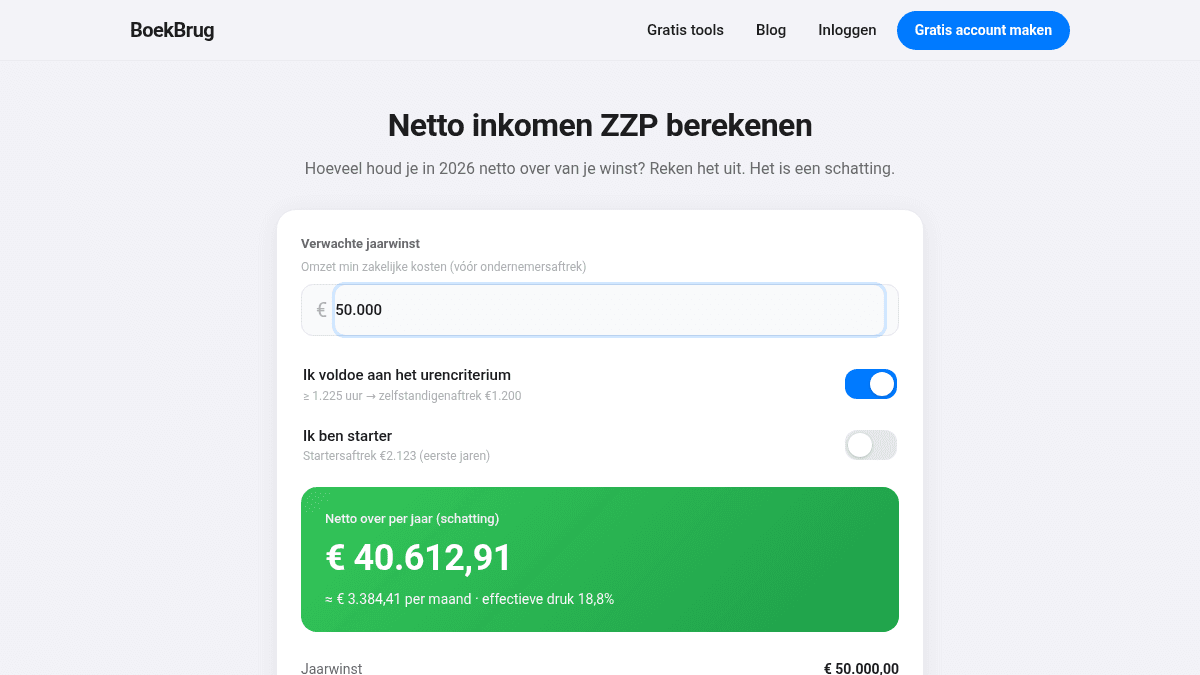
Example with € 50,000 profit (hours rule met, not a starter):
| Step | Amount |
|---|---|
| Profit | € 50,000 |
| Less: self-employed deduction | − € 1,200 |
| Profit after deduction | € 48,800 |
| Less: SME profit exemption (12.7%) | − € 6,198 |
| Taxable income | € 42,602 |
Without the deduction, your taxable income would be about € 1,000 higher. You pay roughly 35.75% tax on that in the first bracket. So the deduction is still worth hundreds of euros a year — even though it is lower than before.
Keep it simple with BoekBrug
The deduction only works if your profit and hours are correct. In BoekBrug your invoices, costs and results sit in one place, so your profit is added up per quarter and you don't have to rebuild anything at year-end. Want to see what the deduction does for you? Use the free net-income tool below — it already includes the self-employed deduction, the starter's deduction and the SME exemption.
Important: this is an estimate, not tax advice
The amounts above are for 2026 and are meant to show the structure. Your situation may differ (part-time, a partner who works with you, other income, pension age). Rates can change. For your exact figures, check the Belastingdienst or your bookkeeper.